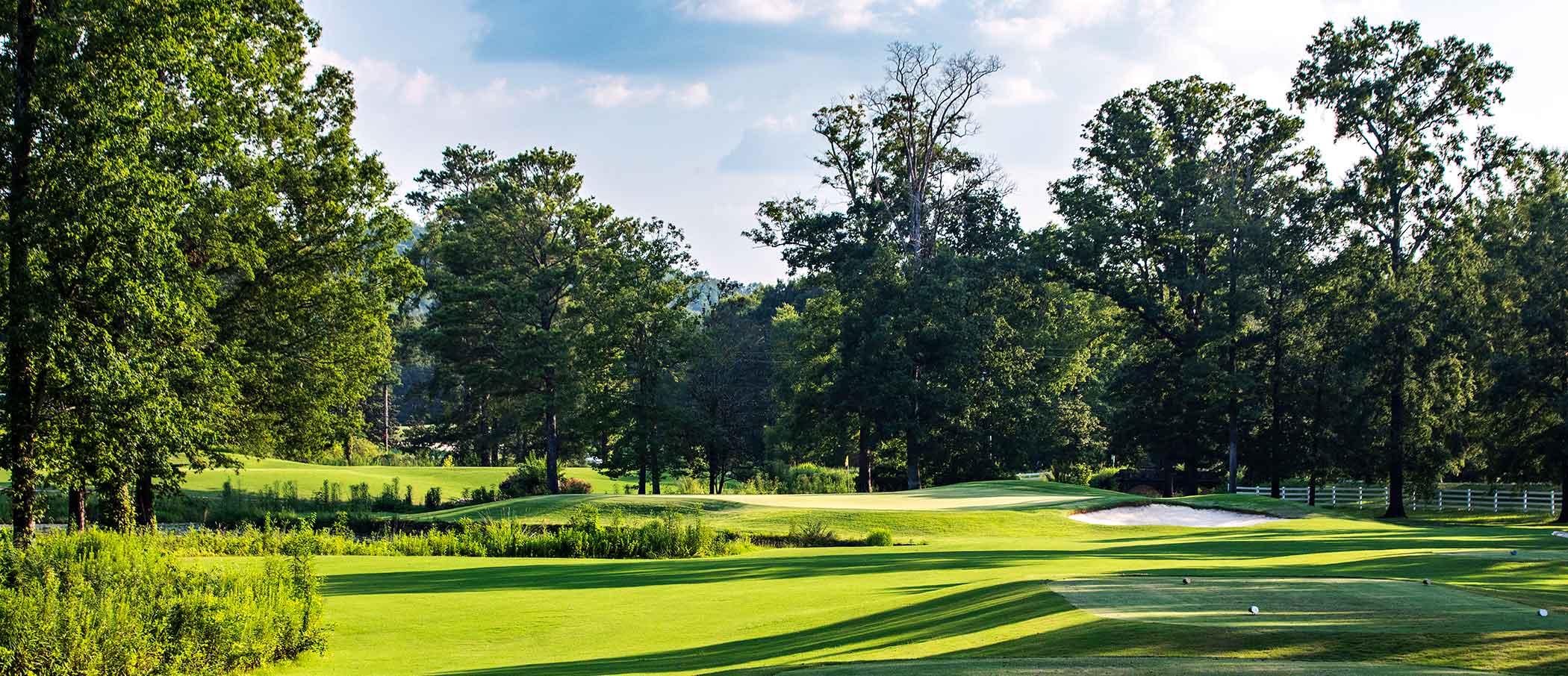
The RTJ Golf Trail Sites Have Natural Beauty & Classic Design Principles
By Mark Fagan | July 20, 2026
In 1990, Dr. David G. Bronner, CEO of the RSA, began selecting sites for a collection of public golf complexes (The
Trail) around Alabama. Robert Trent Jones, Sr. (Jones), at age 83, became the golf course architect for The Trail
which now consists of 450 golf holes at 11 sites. From 1930-1990, Jones advanced modern golf around the world
with his design philosophies and turf methods on the 500 courses he had designed or renovated. Bronner secured
sites with natural beauty in all geographic regions of the state for the golf courses. Each site on The Trail was
chosen based on Jones' design principles as detailed in his 1938 publication called Golf Course Architecture. Each
site provided Jones with enough acreage to transform the blank canvass with his design characteristics for pristine
courses.
The Trail's largest complexes are in more populated areas and the smaller complexes in less populated areas. Each
complex on The Trail is within a manageable drive of another complex on The Trail. The shortened connection
between sites allows for promotion as a golf trail. The trail concept is needed to bring tourists from distant states
and countries to spend several days in Alabama.
The Trail courses are located on lakes, mountain ridges, lowland swamps, scenic valleys, and rivers. The courses
were designed to keep the existing topography of the land and the natural elements undisturbed. The Trail of golf
complexes runs from the Appalachian Mountains in North Alabama to Mobile Bay on the Gulf of Mexico. Oxmoor
Valley and Ross Bridge are on the ridge line of the southern end of the Appalachian Mountains with a valley
between two mountains. Grand National has a 600-acre lake. Hampton Cove is in the Flint River Valley with long
views of surrounding mountains. Cambrian Ridge is on a geographical feature not found in South Alabama.
Magnolia Grove has a jungle environment. Silver Lakes has two large lakes and mountain views. The Shoals is on
the Tennessee River. Capitol Hill incorporates the waters from the Alabama River. Lakewood winds through large
live-oak trees on the eastern shore of Mobile Bay.
Jones said, "Nature provides the raw material. The architect, working with that material without desecrating it,
gives us the final product." Jones used his artistic ability to highlight natural charm and aesthetic appeal at each
site on The Trail. The land dictated the routing of holes and the resulting shot values. The Trail was a design-build
project with much of the design done on-site. This approach helped to prevent duplication of holes on the different
sites. The architects waited until trees were saved or cleared before designing the features on each hole. This
allowed the bulldozer operators to artistically shape the hills and mounds to fit the terrain. The Trail has 40
holding ponds for channeling excess water off the course and improving playability.
Jones said, "There must be a just reward for those attempting the heroic carry, and there must be a way around for
those unwilling to take the risk." The Trail holes have heroic shots, usually in carefully designed par fives, short
par fours, and over water. The Trail courses have interesting elevation changes, punish bad shots, and reward good
shots. These courses provide a test for the good golfers but do not break the spirit of the average golfers.
Tee positions were placed to maximize vistas and greens are nestled in crafted natural settings. Players have to
devise a strategy from the tee for playing that hole. The strategy for each hole varies for the holes on that course.
Up to eight large tee boxes were built on each hole to accommodate players with different abilities. The large tee
boxes provide ample space for divot healing. The Trail holes incorporate modern club distances and ball flight in
their design. The wide fairways forgive errant tee shots.
The skillfully placed fairway bunkers dictate the shot to be played. Fairway bunkers challenge longer hitters and
entice average players into skillfully navigating the hole. Bunkering frames the greens and defends the fairway and
green targets. Jones' "cloverleaf" and "cape and bays" bunkers enhance the routing and highlight the natural
beauty of the land. The rounded "face" bunkers are clearly visible hazards. Jones combined the size, slopes and
contours of his greens to bring the greenside bunkering into play in ever changing ways. Deep or shallow, the
bunkers are an integral part of the green complex and the playability of the hole.
Many of The Trail holes feature beautiful water features that create memorable shot values over the most penal
hazard. Holes play alongside lakes and winding streams and over ponds. Jones used water on The Trail courses to
highlight hole routing and orient players for the best approaches.
The green locations are framed with mounding and bunkering to provide distinct visual appeal and excitement for
approach shots. The large greens provide ample targets for well-pitched shots and spread traffic to reduce
maintenance. The greens have at least four distinct pin areas which are relatively level and separated by contours.
Approach shots that do not hit the correct pin area require a controlled putt over the contours.
For the complete history and economic impact of The Robert Trent Jones Golf Trail in Alabama, visit
https://store.bookbaby.com/profile/MarkFagan and look for The Robert Trent Jones Golf Trail: Its History and Economic Impact, second edition, by Mark Fagan.